The most common reason for gutters overflowing when it rains is a blockage: leaves, moss and silt stop water reaching the downpipe, so it spills over the edge. Other causes include sagging or badly aligned gutters, undersized outlets and very heavy rain. Most can be diagnosed from the ground.
Cause 1: Blocked gutters or outlets
Before anything else, rule out the simplest explanation, because gutters overflowing in a storm are far more often full than faulty.
This accounts for the large majority of cases. Over the year, leaves, twigs, seeds, roof grit and moss wash into the channel and settle near the outlet, where the water slows. Given a few months, the debris rots into a thick sludge that narrows the channel and can seal the outlet completely.
The giveaway is that the overflow happens at a consistent spot, often near a downpipe or at the lowest point of a run, while the rest of the gutter looks fine. A clean usually solves it straight away. If you are seeing other warning signs, our guide to the signs your gutters are blocked will help you confirm it.
Cause 2: A blocked downpipe
Sometimes the gutter is clear, but the downpipe below it is not. Debris that passes the outlet can lodge in a bend or at the shoe at the bottom. Water then backs up the pipe and out of the top of the gutter.
We clear downpipes from ground level upwards. If clearing the pipe does not fix it, the blockage may be in the underground drain, which needs a drainage specialist. Read more in how to unblock a downpipe and downpipe blocked underground.
Cause 3: Sagging or misaligned gutters
Gutters need a very slight fall towards the outlet. If a bracket has failed, a section has dropped or the weight of old debris has pulled a run out of line, water can pool in the low spot and slop over the edge, even when it is not full of debris.
Look for a visible dip, a gap between the gutter and the fascia or a joint that has pulled apart. Fixing it usually means cleaning, refixing the brackets and, where parts are damaged, replacing them. See sagging gutters: causes and fixes.
Cause 4: Leaking or failed joints
Overflow is not always over the top. If water drips from a joint or seam, the seal may have failed or the joint may be filled with debris. Cleaning the section often reduces the drip, but a worn seal or cracked union needs replacing with a new part. We cover this in leaking gutter joints.
Cause 5: Heavy rain, roof shape and capacity
Gutters are designed to cope with typical British rainfall, but a cloudburst can still outpace a standard half-round channel. A few features make it more likely:
- A large roof area draining into a short gutter run with a single downpipe.
- Valleys or dormers that funnel water into one corner.
- Steep roofs that shoot water straight over the gutter lip.
- Missing or poorly placed downpipes.
In these cases, a clean may reduce the problem, but the layout is the cause. A professional can advise whether a larger gutter profile, an extra downpipe or a splash guard is worth considering, as a matter of installation rather than cleaning.
Cause 6: The gutter is too small or poorly set
Sometimes the original installation is the issue. If the gutter sits too high, tiles may drop water behind it. If it sits too low, water can overshoot. Lower tiles may need to overhang correctly into the channel. See water coming over the top of the gutter for the details.
Diagnosing gutters overflowing: a quick table
Pinning down where and when the water escapes narrows the cause considerably. Use the table as a rough guide, then confirm with photos or a professional look.
| What you see | Most likely cause |
|---|---|
| Overflow beside a downpipe | Blocked outlet or downpipe |
| Overflow along a whole run | Heavy debris, or poor fall |
| Water dripping from a seam | Failed joint seal |
| Overflow only in downpours | Capacity, roof shape or minor blockage |
| Overflow at one low point | Sagging section holding water |
| Water behind the gutter | Gutter height or tile overhang issue |
What to do next
Whatever the cause, resist the temptation to wait for a dry spell and forget about it, because the water keeps doing damage every time it rains.
First, look from the ground during or just after rain, and take photos. Do not climb a ladder in wet weather. Gutters overflowing is a problem worth fixing promptly, because the water goes straight onto walls, fascias and foundations. Work above a single storey is best left to professionals.
A clean is the right first step in most cases, and it also reveals any underlying fault such as a split joint or a loose bracket. If you want to know how often to clean, see how often should gutters be cleaned.
How SuperClean Gutters can help
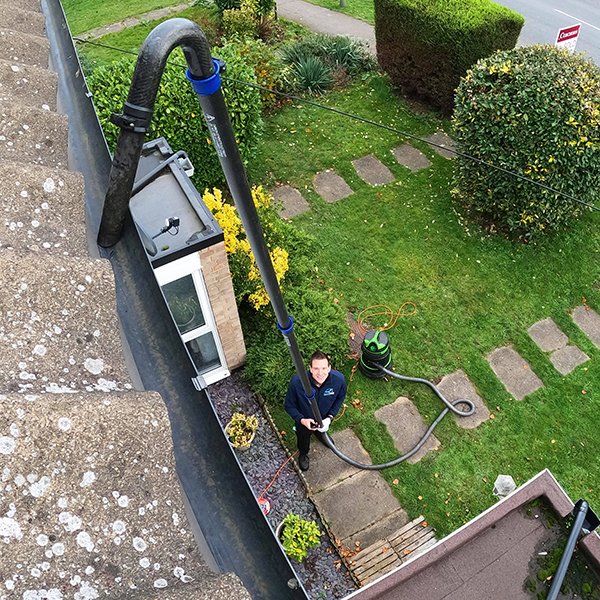
Our gutter clearing service uses a commercial gutter vacuum on high-reach poles up to 12 metres (about 40ft) from the ground, with a camera so you can watch the clear-out. We hand-clear deep debris and outlets from a safe ladder where needed. We work in Walton-on-Thames, Shepperton and Egham, and further afield as shown on our areas we cover page.
If the cause turns out to be a failed joint or a sagging section, our gutter repairs use new parts rather than just sealing the damage. We are fully insured and our work comes with a service guarantee.
Call or WhatsApp 07368 590868 or send photos on WhatsApp for a free quote.
Frequently asked questions
Why are my gutters overflowing even though they are clean?
If the channel is clear, look at the downpipe, the fall and the joints. A blocked downpipe, a sagging section holding water, or a gutter too small for the roof area can all cause overflow. Heavy rain and valleys that funnel water into one corner are other common reasons. A professional can pinpoint the cause.
Why do my gutters overflow in heavy rain only?
That points to a capacity issue or a partial blockage. A slightly narrowed channel can cope with light rain but not a downpour. Roof layout matters too, since valleys and large roof areas concentrate the flow. Cleaning often helps, and an extra downpipe may be worth discussing.
Can overflowing gutters damage my house?
Yes, over time. Constant overflow soaks brickwork, rots fascias and soffits, stains walls and can lead to damp indoors. It also pools water beside foundations. One overflow in a storm is unlikely to cause lasting harm, but repeated overflow should be fixed quickly.
How do I stop my gutters overflowing?
Start with a thorough clean of the gutters and downpipes, then check for sagging sections, loose brackets and leaking joints. If overflow continues, the layout or gutter size may need adjusting. Regular cleaning, once or twice a year depending on trees, prevents most cases.