To unblock a downpipe, first work out whether the blockage is at the top, in the middle or at the bottom, then clear it from the safest position. Most blockages are leaves, moss and silt washed down from the gutter, and they can usually be cleared from ground level. If the pipe is blocked below ground, you need a drainage specialist.
What blocks a downpipe in the first place
A downpipe is a narrow tube, so it does not take much to stop it up. The usual causes are:
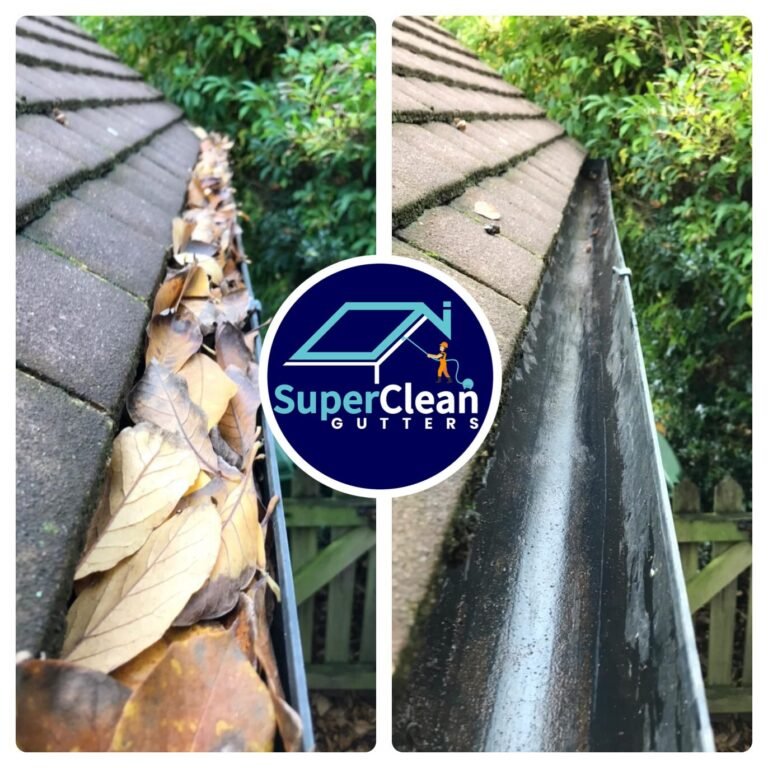
- Leaves and twigs that wash in from the gutter and wedge at the first bend or at the outlet.
- Moss and roof debris. Moss from the roof tiles is carried down by rain and packs the pipe tight.
- Silt and grit. Grit from old mortar and mineral granules from roofing felt settle into a heavy sludge.
- Bird nests and the odd tennis ball. Pipes at the top are an attractive nesting spot, and balls are surprisingly common at the bottom of garden-facing runs.
- Frost damage. Ice can split a joint or form a plug of its own in very cold spells.
How to tell where the blockage is
A blocked pipe leaves clues. Looking at them first saves a lot of time.
| What you see | Likely location |
|---|---|
| Water pours over the gutter near the downpipe | At the top, in or just below the outlet |
| Water leaks from a joint partway down the pipe | Somewhere above that joint |
| Pipe runs clear but water pools at the base | The drain or gully at ground level, or underground |
| Gutters flow in dry weather but not in heavy rain | A partial blockage, often a bend or the outlet |
| Gurgling or bubbling noises from the pipe | Trapped air behind a blockage |
Safe ways to unblock a downpipe from the ground
Do not climb to the top if you are unsure of your footing. Work that is above a single storey is best left to professionals. There are still sensible steps you can take with both feet on the ground.
- Check the base first. Lift out any grating or gully cover at the bottom and look for leaves or a build-up of silt. Wear gloves, as the debris is often rotten and sharp.
- Try gentle water pressure. A garden hose pushed into the bottom of the pipe with the water running can flush out a soft plug. Do it slowly so the pipe does not burst a weak joint.
- Use a flexible tool. A plumber's rod or drain auger can push through light debris. Do not force it, as hard prodding can crack old plastic or cast iron.
- Tap the pipe. A light tap along the length can loosen a blockage at a bend. Do not hit it hard.
- Stop if it will not shift. If the hose backs up or the pipe is firmly jammed, the blockage is probably compacted or lower down.
Avoid caustic chemicals and do not push a rigid object up a downpipe from a ladder. Neither is a good idea for a plastic system, and a fall from a ladder is a far worse outcome than a wet patio.
When it is not a simple blockage
Sometimes you clear the pipe, the water still will not drain, and the real problem is below ground. Most downpipes feed into a gully or underground drain. If that drain is blocked, full of roots or collapsed, water has nowhere to go and will rise back up the pipe. We clear downpipes from the ground up, but we cannot clear below-ground drains, and in that situation we would recommend a drainage specialist. Our guide to a downpipe blocked underground explains how to spot it.
Other problems include a split joint, a pipe that has come away from the wall or a bracket that has failed. Those need gutter repairs, with new parts fitted where the old ones are damaged.
How to stop it happening again
- Have the gutters cleared at least once a year. Most downpipe blockages start in the gutter above.
- Keep the roof clear of heavy moss, since it drops straight into the system.
- Trim branches that overhang the roof. Our post on trees near your house and your gutters explains why they matter.
- Check the bottom of each downpipe after a storm or leaf fall.
- Think about whether gutter guards would suit your house. They help in some cases, but not all, as we explain in our guide on whether gutter guards work.
Professional help for a stubborn downpipe
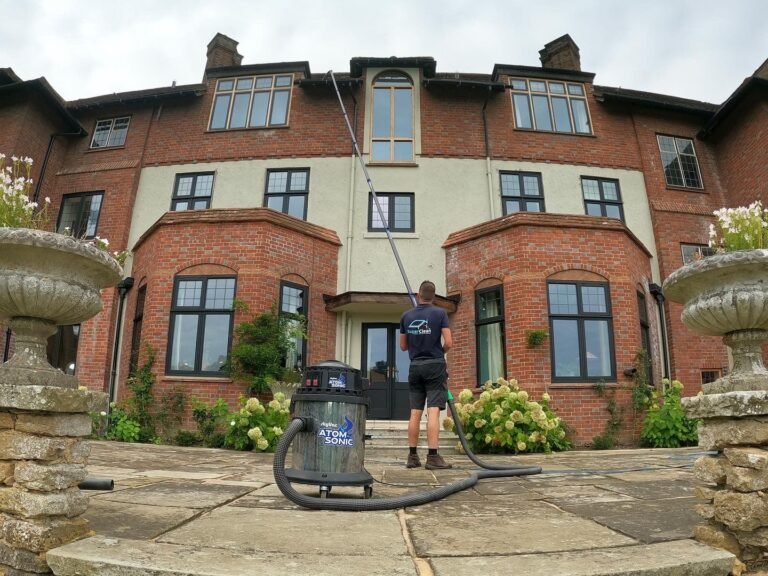
Where a downpipe will not clear, a gutter vacuum with high-reach poles can pull debris from the outlet and the top section of the pipe, all from the ground. A camera on the pole lets us see what we are dealing with. For deeper debris, we use safe ladder access to clear outlets by hand.
We clear gutters and downpipes across Ripley, Egham and Leatherhead, among many other places listed on our areas we cover page.
How SuperClean Gutters can help
Our gutter cleaning includes clearing the downpipes from ground level up, so water can leave the roof freely. The team is fully insured, the site is left tidy and our work is backed by our service guarantee. You do not need to be home, as long as we have safe access and an outside power socket.
Send your address and a few photos of the guttered sides of the house, taken from below, and we will usually quote the same day.
Call or WhatsApp 07368 590868 or send photos on WhatsApp for a free quote.
Frequently asked questions
How do I know if my downpipe is blocked?
Typical signs are water spilling over the gutter near the pipe, leaks at a joint, damp stains on the wall below and gurgling noises. Pour a little water into the gutter on a dry day. If it drains slowly or backs up, something is in the way.
Can I unblock a downpipe with a hosepipe?
Often, yes, if the blockage is soft debris near the bottom. Feed the hose in gently and turn the water on slowly. Stop if water comes back at you or a joint starts to leak. Compacted blockages need a different approach or a professional.
Is it safe to unblock a downpipe from a ladder?
For a single-storey outlet in good conditions, careful DIY is possible, but ladders cause many avoidable injuries. Anything higher is best left to professionals. Clearing from the ground, with a vacuum on poles, avoids the risk altogether on most houses.
What if the downpipe is clear but water still backs up?
Then the blockage is probably in the drain or gully it feeds, below ground level. That is not something a gutter cleaner can fix. A drainage specialist can camera the pipe, find the cause and clear it, whether it is silt, roots or a broken section.