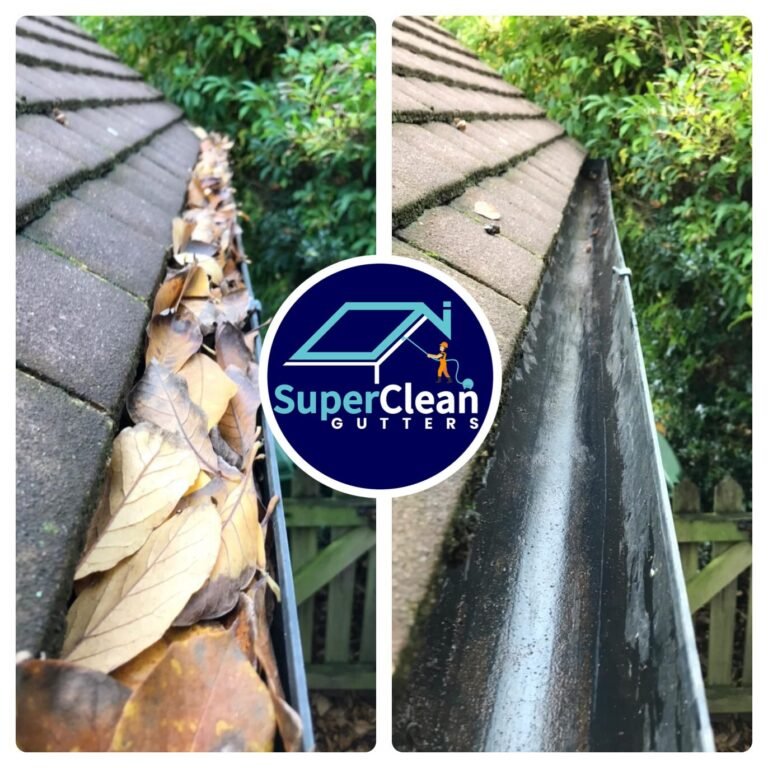
Yes, blocked gutters damp problems are real: when gutters overflow, water runs down the wall instead of away through the downpipe, and over time it can soak the brickwork, rot timber and show up as damp patches indoors. Clearing the gutters is usually the first and cheapest step towards stopping it.
How blocked gutters lead to damp
A gutter has one job: to collect rain from the roof edge and carry it to a downpipe. When leaves, moss and silt fill the channel, the water has nowhere to go. It spills over the front lip, or backs up behind the gutter, and falls down the face of the house. Brick and render are porous, so a wall that is soaked again and again slowly takes on moisture.
In heavy rain you might see it happen. More often it goes on quietly during the wet months, which is why the first sign is frequently a stain or a patch inside, not a visible waterfall outside.
Where the water goes
Overflowing water finds the easiest route. In practice that tends to be one of a few places.
- Down the outside wall. Constant wetting causes dark streaks, green algae and, eventually, penetrating damp that can reach the plaster inside.
- Behind the gutter. If the water runs back towards the house, it can wet the fascia, the soffit and the roof timbers at the eaves.
- Into the roof edge. A gutter that is full to the brim can push water under the bottom row of tiles or felt.
- Onto the ground at the foot of the wall. Repeated saturation around the base of a wall is a common route for damp at low level.
Signs your gutters may be causing damp
Damp has several possible causes, so it is worth looking at the pattern. With blocked gutters damp usually appears in the same few spots, close to the roof edge or a downpipe. Clues that point at the gutters include:
- Stains or green marks that run in streaks directly below a gutter or joint.
- Damp patches on an internal wall that sits just under a roof edge or beneath a downpipe.
- Peeling paint or bubbling plaster on an outside-facing wall after periods of rain.
- Water visibly pouring over the front of the gutter during a downpour.
- Plants, moss or even small saplings growing in the gutter itself.
Our guide to the signs your gutters are blocked goes through these in more detail, and why gutters overflow covers the other common causes.
Blocked gutters are not always the culprit
This is worth saying plainly, because damp is often blamed on the wrong thing. Condensation, a failed damp-proof course, a leaking pipe, cracked render, a gap around a window frame or a defective roof can all cause similar marks. A gutter blockage makes any of these worse, but it may not be the only problem.
If you are not sure, a sensible first step is to have the gutters cleared and then watch whether the marks stop spreading over the next few wet spells. If they do not, a damp specialist or a surveyor can look at the wider picture. We would sooner tell you that than promise a cure that is not there.
What to do if you suspect your gutters are causing damp
- Look from the ground. On a dry day, check for overflow stains, plants growing in the gutters and joints that look separated.
- Watch during rain. If it is safe to do so, stand somewhere dry and see whether water pours over the edge or drips at a joint.
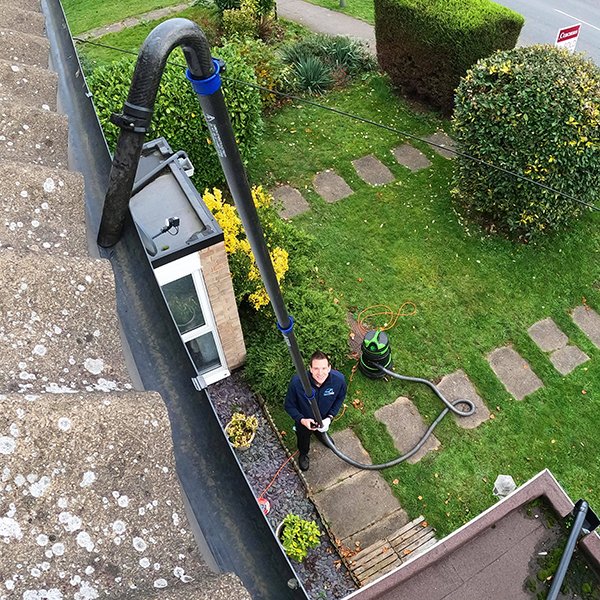
- Get the gutters cleared. This removes the main cause of overflow. From the ground, a vacuum with a camera shows you the inside of the gutter.
- Have damaged parts repaired. Cracked joints, loose brackets and sagging runs keep leaking even when they are clear.
- Dry out and monitor. Walls need time to dry. Keep an eye on the affected area through the next few weeks.
Please do not climb a ladder to look yourself unless you are confident and the work is at a single storey. Anything higher is best left to professionals.
Keeping the damp away
Regular clearing is the simplest way to head off blocked gutters damp trouble before it starts. Houses under or near trees need it more often, and so do those with flat roofs or large conservatories feeding water into the system. Make sure the downpipes run freely too, since a blocked pipe causes the same overflow as a full gutter. If the problem is further down, in an underground drain, a drainage specialist will need to deal with it.
We work across Surrey, including Esher, Guildford and Chertsey, and the full list is on our areas we cover page. If the gutters themselves have failed, gutter repairs using new parts, not just sealant, give a more lasting fix.
How SuperClean Gutters can help
Our gutter cleaning team uses a commercial gutter vacuum with high-reach poles up to 12 metres and a camera, so you can see the before and after photos. Where there is deep debris around an outlet, we use safe ladder access to clear it by hand, and downpipes are cleared from ground level up. If the pipe is blocked below ground, we will say so and suggest a drainage specialist.
Send your address and photos of every guttered side, taken from below, and we will usually quote the same day. The team is fully insured and our work is backed by our service guarantee.
Call or WhatsApp 07368 590868 or send photos on WhatsApp for a free quote.
Frequently asked questions
Can blocked gutters cause damp inside the house?
They can contribute, and blocked gutters damp complaints are something we hear about often after a wet autumn. Overflowing water soaks the outside wall, and over time moisture can travel through porous brick to the inner surface. Gutters are only one possible cause, though, so if damp persists after the gutters are cleared, a damp specialist should look at other sources.
How can I tell if damp is from my gutters or from condensation?
Gutter-related damp tends to sit on outside-facing walls near the eaves or below a downpipe, and it is worse after rain. Condensation appears on cold surfaces and in poorly ventilated rooms regardless of the weather. Dark streaks outside, directly below a joint, point towards the gutters.
Will cleaning my gutters dry out damp walls?
Clearing the gutters stops new water soaking the wall, which lets it dry out naturally. That can take a few weeks depending on the wall and the weather. Cleaning will not repair damaged plaster or render, and it will not fix damp from other causes.
How often should I clear gutters to prevent damp?
For most homes, at least once a year, and more often if you have overhanging trees or the gutters fill quickly. After a wet autumn it is worth checking again. If you see water spilling over in rain, do not wait for the next scheduled clean.