For most houses, the answer to how often should gutters be cleaned is at least once a year, and twice a year if you have overhanging trees or a lot of leaf fall. Autumn, once the leaves have dropped, is the single most useful time to do it. Here is how to work out the right rhythm for your own home.
The short answer: once or twice a year
A typical Surrey house with a few small garden trees nearby is fine with one thorough clean a year. The trouble is that “typical” covers very little. A bungalow beside a mature oak sheds far more into its gutters than a modern semi on an open estate, and the two need very different schedules.
As a rule of thumb, think in terms of how much debris your gutters actually catch rather than the calendar. If you can see weeds, moss or leaf litter in the channel from an upstairs window, or if water spills over the front during a heavy shower, the gutters are already overdue.
What changes the schedule
When people ask how often should gutters be cleaned, the honest reply is that it depends on what surrounds the house. Several things push a home from “once a year” to “twice a year” or more:
- Trees within a few metres. Oak, sycamore, beech and silver birch drop leaves, seeds and twigs that end up in the channel. Evergreens such as pine and cypress shed needles all year, which quietly compact into a dense mat.
- Roof type and age. Older concrete tiles shed grit and moss, and those granules wash straight into the gutter.
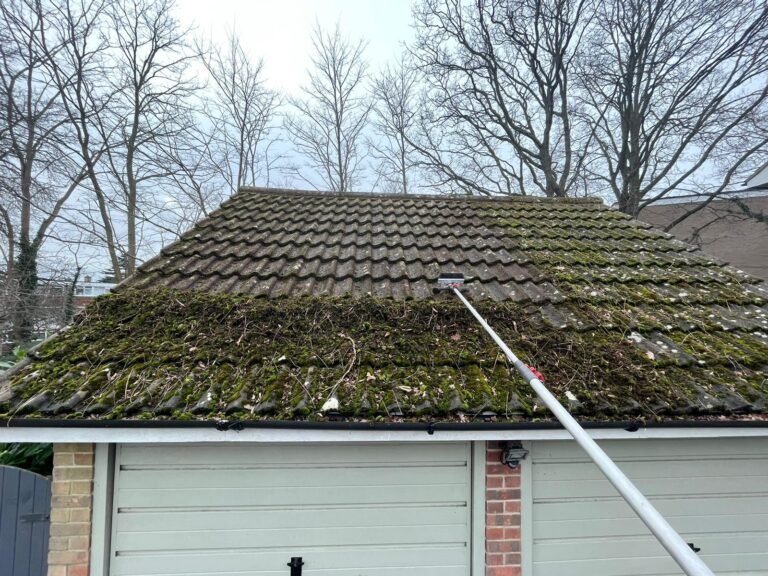
- Moss on the roof. Moss that has been scraped or has loosened in wet weather falls into the channel in clumps. If you have moss on the roof, expect more frequent gutter work.
- Low-pitched or flat sections. Water moves slowly here, so silt and debris settle instead of washing through.
- Nearby birds and nesting. Gutters under eaves and above porches are favourite spots for nests.
A simple frequency guide
| Your situation | Suggested frequency |
|---|---|
| No trees nearby, newer roof, open plot | Once a year |
| A few trees in the garden or road | Once a year, after leaf fall |
| Large deciduous trees overhanging the roof | Twice a year (late autumn and late spring) |
| Evergreens or conifers close by | Twice a year, sometimes three times |
| Heavy moss on the roof | Every six months until the roof is treated |
| Flat-roof or low-pitch sections | Check twice a year, clean as needed |
Signs you should not wait for the next scheduled clean
Even a sensible routine can be overtaken by a storm or a windy week. Do not wait for the diary if you notice any of these:
- Water pouring over the front edge during moderate rain.
- Green or black staining running down the wall beneath a joint or corner.
- Plants, grass or small saplings growing out of the gutter.
- A downpipe that gurgles, or stays dry when it is clearly raining on that side.
- Damp patches on the soffit, or peeling paint on the fascia board.
Our guide to the signs your gutters are blocked covers these in more detail.
Why regular cleaning matters
Knowing how often should gutters be cleaned is only useful if you stick to it, and the reason is simple: small, regular jobs prevent big, expensive ones.
A blocked gutter is not just untidy. Water that cannot drain sits in the channel, adds weight and strains the brackets. Overflow runs down the face of the wall and soaks the brickwork, and over time it can reach the fascia, soffit and even the timbers behind. Wet, rotting debris also freezes in winter, which stresses plastic joints.
Keeping up with a routine is almost always cheaper and easier than repairing the damage that builds up when blockages are left. A short, regular clean also means the job is quick, with less risk of hidden problems such as cracked joints going unnoticed, because you are removing a season of debris rather than several years of compacted sludge.
Doing it safely
If you are thinking of doing it yourself, be realistic about the risks. Falls from ladders are a leading cause of household injury, and gutters are exactly where people overreach. Anything above a single storey is best left to professionals, and even at ground-floor level you should have someone footing the ladder and never lean sideways.
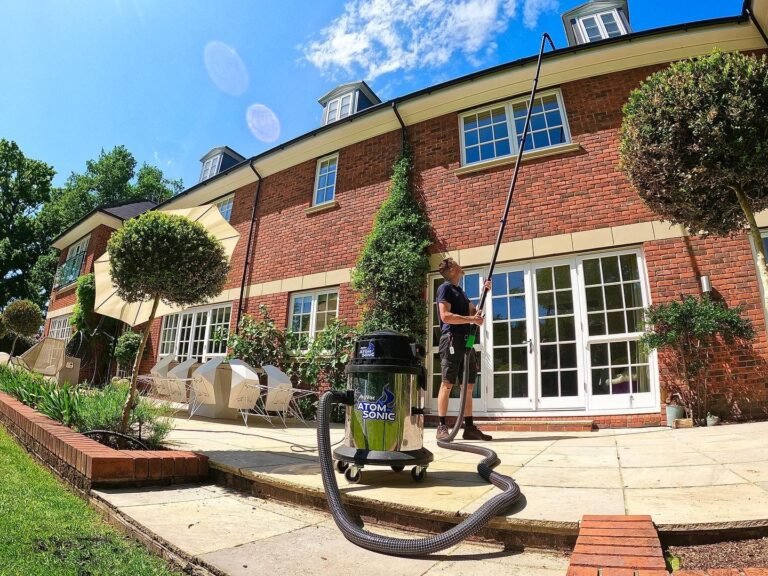
Many homes also have gutters that cannot be reached safely by ladder at all, such as those above conservatories, extensions or garages. A pole-based vacuum system avoids all of that by working from the ground.
How SuperClean Gutters can help
Our gutter cleaning service uses a commercial gutter vacuum on high-reach poles that extend up to 12 metres (about 40ft) from the ground, with a camera on the pole so you can see before and after photos. Where deep debris or outlets need hand-clearing we use safe ladder access, and gutters above conservatories and extensions are cleaned from the ground. We clear gutters across Weybridge, Cobham and Woking, and you can see the full list on our areas we cover page.
If you tell us about the trees and roof around your home, we can suggest a sensible schedule. If the roof itself is shedding moss, our roof cleaning and moss removal service tackles the cause. You do not need to be at home, as long as we have safe access and an outside power socket, and we leave the site tidy.
Call or WhatsApp 07368 590868 or send photos on WhatsApp for a free quote.
Frequently asked questions
Is cleaning gutters once a year enough?
For many homes, yes. If you have few or no trees nearby and a fairly modern roof, one thorough clean a year in autumn, after the leaves have fallen, is usually enough. If you have overhanging trees, conifers or lots of roof moss, twice a year is a safer routine, and an extra check after a big storm is wise.
Should gutters be cleaned in spring or autumn?
Autumn is the most important, because it clears leaves before the wettest months of the year. Spring is a useful second clean for homes near trees, removing seeds, blossom and winter debris. If you only do one, choose late autumn once most of the leaves are down.
How do I know if my gutters need cleaning?
Look for water spilling over the edge in rain, staining on walls below the gutter, plants growing in the channel, or a downpipe that does not run during a downpour. From the ground you can also spot sagging sections or visible debris at the front lip. A camera on a pole gives a clear view without a ladder.
Do new gutters need cleaning as often?
New gutters still collect debris at the same rate, so surrounding trees and roof condition matter more than the age of the gutter. A new install is smoother and drains well, but leaves, moss and seeds will still build up. Keep to the same yearly or twice-yearly routine, and check outlets after storms.